Water treatment
Tramping is not the place to get sick, and Giardia or Norovirus can make you really sick.
Hand sanitiser, filtering water, and water treatment tablets can offer a false sense of security from infection.
Hand sanitiser
Alcohol-based sanitisers work well for E. coli and 99% of common bacteria and viruses. Unfortunately, the New Zealand backcountry has the potential for that remaining one per cent of pathogens where sanitiser just doesn’t work.
Giardia is a protozoan parasite with a tough cyst shell. Cryptosporidium is a protozoan parasite protected by an oocyst wall. Norovirus is a non-enveloped virus. Campylobacter is a bacterium and is easier to kill.
All four pathogens are largely unaffected by alcohol sanitiser.
You need soap to loosen the skin’s natural oils where they attach, 20 seconds of physical friction to scrub them free, and then running water to rinse them off.
Use sanitiser for the general 99%, but liquid soap gets rid of them all if done correctly. Note that soap doesn’t break down the pathogen’s shell and render them ineffective. It simply aids in the physical rinsing process.
Filters
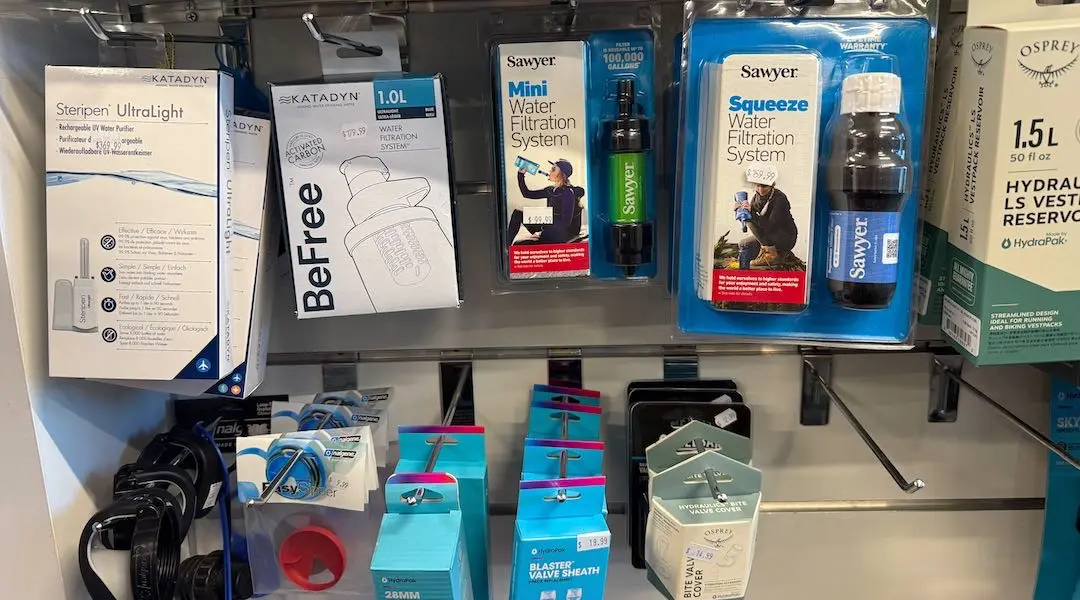
Filters usually use 0.1–0.2 µm hollow-fibre membranes that filter out larger pathogens, like Giardia and Cryptosporidium. Tiny Norovirus, however, sails right through.
Filtering is essential in Europe or North America, as backcountry water commonly carries pathogens in numbers high enough to infect people. In those countries, wild animals create significant contamination in running water. Beavers build dams and defecate directly into slow-moving streams. Bears live alongside waterways, and feces easily wash in.
The South Island and Rakiura have a relatively low density of wild animals carrying human-adapted strains of these bugs. Then the deposits need to get into running water. Steep alpine streams oxygenate the water, turbulence breaks up organic matter and dilutes microbes, and natural UV at altitude helps neutralise pathogens.
Stream water in the remote backcountry of the South Island or Rakiura is generally low risk, although anywhere in the vicinity of farms or where water is slow-moving, it’s safer to filter or boil to be sure.
Slow-moving streams, particularly if they flow through paddocks, can be contaminated, as can streams immediately downstream of huts. Some people do disgusting things in the bush to avoid sharing a long drop.
Wild birds and rodents generally don’t carry human-adapted species or strains of Giardia. While bird droppings on hut roofs can carry E. coli and Campylobacter, these pathogens tend to bind to organic matter from the roof and sink into the sludge at the bottom of the rainwater tank, where they break down.
Tablets
Tablets are no great panacea either.
Aquatabs do not work against Cryptosporidium due to its resistant oocyst wall, though they are effective against Giardia after 30 minutes.
Katadyn Micropur MP1 (chlorine dioxide) can kill Cryptosporidium, but you must leave it in the bottle for up to 4 hours! Standard Micropur Forte takes 30 minutes for bacteria/viruses and two hours for Giardia, but does not kill Cryptosporidium.
Iodine is no longer recommended as it accumulates in the thyroid, leaves a harsh chemical taste, and is ineffective against Cryptosporidium. Chlorine-based products are now preferred.
UV sterilisation
UV light works against all four of these pathogens, but it requires crystal-clear water. Furthermore, raw water trapped on the outer bottle rim or screw threads bypasses the light entirely, so you can easily contaminate your drink without knowing it.
What works
Bringing water to a rolling boil is the most reliable option for contaminated water, but most remote wilderness water carries a very low risk to begin with. All four pathogens break down at 60–70º C.
The real risk is the communal rainwater tank tap that everyone touches, which then spreads pathogens to the door latches, long-drop handles, and kitchen benches.
Careful handwashing is your best defence against infection. Then, using a dry paper towel to touch toilet door latches and tap handles goes a long way.